Welcome to Law and Disorder Radio
Law and Disorder is a weekly independent civil liberties radio program airing on more than 150 stations and on Apple podcast. Law and Disorder provides timely legal perspectives on issues concerning civil liberties, privacy, right to dissent and practices of torture exercised by the US government and private corporations.
Law and Disorder March 4, 2019
Podcast: Play in new window | Download
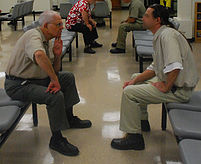
In hundreds of correctional facilities across the nation, in person visits are being phased out. Instead, video technology run by Securus and other companies is used to replace these visits. One researcher at the Prison Policy Initiative has pieced together hard to gather stats that suggest at least 600 US prisons have video visitation programs in place. In Florida, for example, on retired prison inspector who writes about video visitation, says that over the past five years, most jails there are using only video visitation and have altogether stopped in-person visitation.
The Prison Policy Initiative’s data suggests that 74% of US correctional facilities that implement video calling end up either reducing in-person visits, or totally eliminating them. Is the elimination of prison visits a human rights violation? Most prisoners receive few, if any visitors, or human contact.
Guest – Steve Gotzler, executive director of the Prison Visitation and Support. Steve is the former program director at the Pennsylvania Prison Society, and he knows firsthand what it’s like to spend time in federal prison.
—-

Supreme Court Rules On Civil Forfeiture
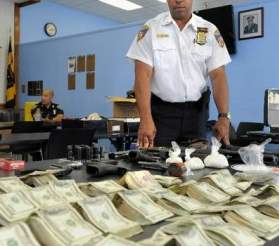
In a unanimous decision, the U.S. Supreme Court recently ruled that the Constitution limits the ability of state and local law enforcement to seize and then use cash, property, and other assets that may have been used the commission of crimes, especially when used to fill the coffers of police departments. Law enforcement need only suspect the property has been used as a crime; they don’t need to charge you.
Ruth Bader Ginsburg wrote the opinion on her first day back at the court. Civil liberties organizations have criticized this practice for years. That’s because many local governments use these fines to raise revenue, increasing incentives for arrests.
Not surprisingly, civil asset forfeiture disproportionately affects vulnerable communities, notably African Americans and lower-income neighborhoods. In the state of South Carolina, for example, The Greenville News reported that the state took $17 million from seizures from 2014 to 2016. Sixty-five percent of those targeted were African American. The high Court said that fines may not be excessive, and that states are currently using excessive fines for improper purposes, including for raising revenue.
Guest – Josie Duffy Rice is a lawyer and writer in New York. Josie is a former research director with the Fair Punishment Project.
Law and Disorder February 25, 2019
Podcast: Play in new window | Download
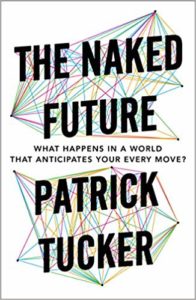

Cyber Threats And US Cyber Security
Russian hackers need only 19 minutes after breaking into a computer to wreak greater destruction and data theft, according to a recent CrowdStrike report. The Kremlin beat out North Korean and Chinese hacker groups who needed two and four hours respectively to go from breaching one computer to another. Cyber threats from Russia are sophisticated and aggressive, according to earlier findings and many experts. As a results Russian saboteurs have moved beyond network intrusion into data manipulation and taking down power systems.
Guest – Patrick Tucker, technology editor for Defense One. Patrick is the author of the 2014 book, The Naked Future: What Happens in a World That Anticipates Your Every Move? Previously, Tucker was deputy editor for The Futurist. He has written widely about emerging technology for such publications as Slate, MIT Technology Review, and BBC News Magazine.
—-
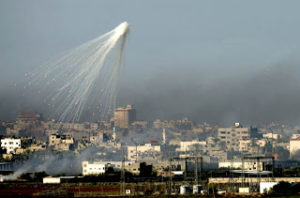

10 Years Since Operation Cast Lead
Last month marked the 10 year anniversary of Israel’s illegal massive deadly attack on the Palestinian people living in the open air prison of the Gaza Strip along the Mediterranean sea in the south of Israel-Palestine.
The attack was carried out with the political and military support of the George W. Bush regime during its final few days. Some 1200 Palestinians were killed including 500 children. This has been documented in the United Nation’s sponsored Goldstone Report.
Israel’s continuing illegal settlement of Palestinian land and it’s dispossession of Palestinian people is made possible by American political, military, and economic support. But this support is coming under increasing challenge with Israel’s violation of human rights and of international law being more widely exposed and discussed.
Guest – Helena Cobban is the publisher of Just World Books and is active through her new not-for-profit organization Just World Educational. She works in broad community education campaigns on matters of war, peace, and justice in the Middle East.
——————-
——————-
Law and Disorder February 18, 2019
Podcast: Play in new window | Download

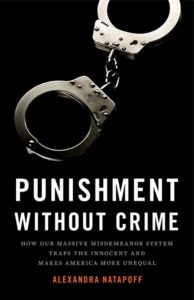
In the overburdened U.S. criminal justice system, with its burgeoning prison population, we hear a lot about felony convictions. Felonies are crimes usually punishable by a term of more than one year, or the death penalty. What we don’t hear much about are misdemeanors, low level offenses punishable by fines or short terms of imprisonment in local jails.
With ten million petty cases filed annually, most U.S. convictions are misdemeanors. Unlike felonies, however, their processing is typically informal and deregulated. Much like fast-food justice, they have high-volume arrests, weak prosecutorial screening, an overtaxed defense bar, and high plea rates. There is often little meaningful scrutiny to see if convictions are supported by evidence. Innocent people who can’t afford bail often plead guilty just to get out of jail.
What the result of misdemeanor convictions? It’s pretty serious: stigma of a criminal record, misdemeanants are often heavily fined, incarcerated, and/or lose jobs, housing, and educational opportunities. Petty convictions are more frequent and burdensome even as we devote fewer institutional resources to ensuring their validity.
The misdemeanor phenomenon has profound systemic implications. It invites skepticism about whether thousands of individual misdemeanants are actually guilty. It reveals an important structural feature of the criminal system: that due process and rule-of-law wane at the bottom of the penal pyramid where offenses are pettiest and defendants are poorest. Misdemeanor processing is the way poor defendants of color are swept up into the criminal system with little or no regard for actual guilt.
In her new book, Punishment Without Crime: How Our Massive Misdemeanor System Traps the Innocent and Makes America More Unequal, Law Professor Alexandra Natapoff takes an in-depth look at the misdemeanor process is an institutional gateway that explains many of the criminal system’s dynamics and dysfunctions.
Guest – Alexandra Napatoff, University of California Irvine law professor and a member of the American Law Institute. She’s also a former federal public defender, a community organizer, and the recipient of an Open Society Institute Community Fellowship.
—-
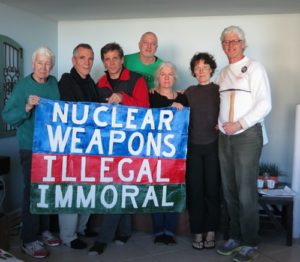
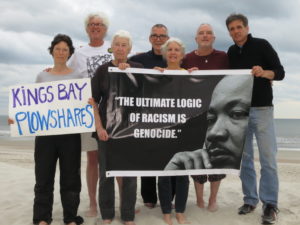
In our society nuclear weapons that can destroy all creation are taken as a normal, even an inevitable, part of life. In a dramatic action to break what they call “the crime of silence“ seven Catholic peace activists entered the Kings Bay trident submarine base in Georgia last April to perform an act of symbolic disarmament.
They used hammers to follow the prophecy of Isaiah “to beat swords into plowshares” and poured blood to make holy what was evil in a sacramental action.
Kings Bay is homeport to six ballistic missile trident submarines, each of which deploy 16 trident missile’s carrying four or more warheads of at least 100 kilotons. The Hiroshima bomb was 14 kilotons. Each submarine thus has the distructive power of at least 500 Hiroshima bombs.
The plowshares seven face up to 25 years in federal prison. Their trial is coming up in the next month. Theirs was the latest of 100 plowshares actions around the world since 1980.
- www.twitter.com/kingsbayplow7
- http://facebook.com/Kingsbayplowshares/
- instagram.com/kingsbayplowshares7/
- facebook.com/groups/1558500837566350/
- Media: [email protected] General: [email protected]
Guest – Martha Hennessey, Kings Bay Plowshares 7 co-defendant, activist and volunteer with the New York Catholic Worker.
Guest – Carmen Trotta, Kings Bay Plowshares 7 co-defendant, activist and volunteer with the New York Catholic Worker.
——————
——————