Civil Liberties, Human Rights, Human Trafficking, Supreme Court, Truth to Power, War Resister
Podcast: Play in new window | Download
U.S. Quits UN Human Rights Body
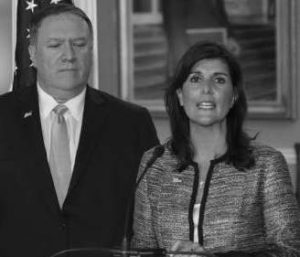
Last week the United States of America became the first country to voluntarily quit the United Nations 47 member main human rights body, primarily over Washington’s claim that the Human Rights Council is biased against Israel.
This was the Trump administration‘s latest snub of the international community. The Human Rights Council is tasked with spotlighting and approving investigations of suspected rights abuses. Never before has a member dropped out voluntarily. Diplomats and activists say that US ambassador Nikki Haley was the driving force behind the decision.
Efforts by the United Nations ambassador Haley to end or water down the routine scrutiny of Israel has failed in recent months at the United Nations General Assembly in New York. The Human Rights Council addresses and array of concerns including discrimination, freedom of expression, the rights of women, LGBT people, and people with disabilities.
Haley declared that “We are withdrawing from the United Nations Human Rights Council, an organization which is not worthy of its name.“
Guest – Phyllis Bennis is a fellow of the Institute for Policy Studies, where she works on anti-war, US foreign policy and Palestinian rights issues. She has worked as an informal adviser to several key UN officials on Palestinian issues. Her books including Calling the Shots: How Washington Dominates Today’s UN, and Understanding the Palestinian-Israeli Conflict.
—-
Mark Crispin Miller – Julian Assange, Voter Fraud and Fake News
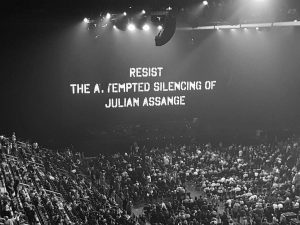
WikiLeaks founder the truth telling publisher Julian Assange is in escalating danger of being sent from England to America where he would likely be tried for espionage, a crime that carries the death penalty.
Assange and WikiLeaks have revealed American war crimes in the middle east, CIA global machinations , and the work of Clinton Democrats in preventing the popular Bernie Sanders from heading up the party ticket.
Assange is presently holed up in the Ecuadorian embassy in London where he was granted political asylum six years ago by past leftist president Rafael Correa. But now, with the change of presidents in Ecuador, Assange has been cut off from the outside world. He has no phone, no computer, and no visitors.
The fresh offensive against him occurred the day after American General Joseph DiSalvo, the head of the US Southern Command, the Pentagon’s arm in Latin America, visited the new right wing Ecuadorian President Lenin Moreno. Moreno has said that Assange is “an inherited problem” and is seeking s better relationship with the United States government, to whom he has already granted a military base.
Guest – Mark Crispin Miller who is a professor of media studies at New York University. Professor Miller has frequently spoken about media propaganda, the engineering of consent for empire, fake news, and the destruction of the independent press. He has been awarded a Guggenheim Fellowship for the humanities and is a vigorous defender of Julian Assange and WikiLeaks.
—————————–

—————————–
Civil Liberties, Criminalizing Dissent, Human Rights, Supreme Court, Truth to Power, War Resister
Podcast: Play in new window | Download
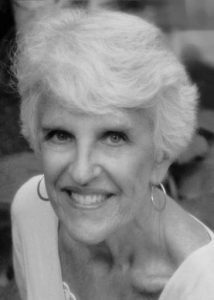
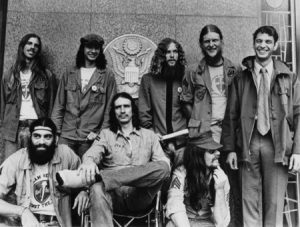
Lawyers You’ll Like: Attorney Nancy Stearns
In 1970, an unusual legal team came together in what would become a landmark case challenging New York’s restrictive abortion ban. The case was Abramowicz v. Lefkowitz, and the team consisted of all women, many of whom had just a few years of legal practice. The premise was equally unusual at the time: its critical testimony came directly from women who had had illegal abortions, lack of contraceptive access, and painful experiences either from adoption or forced motherhood.
One of those attorneys included Nancy Stearns. After the Abramowicz case influenced the state’s passage of the nation’s most liberal abortion law before Roe v. Wade, Nancy would go on to bring successful challenges to abortion laws in NJ, CT, RI and MA.
Nancy attended law school after working with the Student Nonviolent Coordinating Committee (SNCC) in Atlanta. For 12 years at the Center for Constitutional Rights she worked on a number of significant civil rights cases, including challenging New York City’s mandatory pregnancy leave policy in Monell v. Department of Social Services that resulted in a Supreme Court ruling that municipalities are liable for damages under 42 U.S.C. 1983. She represented members of Vietnam Veterans Against the War in a federal criminal conspiracy prosecution arising from anti-war protests, and she litigated to reunite families separated by the Babylift, in which Vietnamese infants and young children were brought to the U.S. for adoption at the close of the Vietnam War, despite having living parents.
Nancy is also an accomplished cabaret singer, making the circuit in New York City. She is a longtime member of the National Lawyers Guild; in fact the Guild’s Chapter is honoring Nancy and her exemplary career at its annual Spring Fling on June 8, 2018.
—-

Cryptocurrencies
In 2008, Satoshi Nakamoto invented Bitcoin, the first and most prominent cryptocurrency, a peer-to-peer electronic cash system. While cryptocurrencies have become an international phenomenon, and many are aware of their importance, yet they are still not completely understood by large financial institutions, governments and much of the public. There are currently more than 1,500 cryptocurrencies, and the list continues to grow.
The general definition of cryptocurrencies are digital currencies using encryption techniques, hence the prefix crypto, to regulate the generation of unites of currency and verify the transfer of funds. This system operates independently of a central bank to create and outlet for personal wealth beyond restriction and confiscation. The U.S. Securities and Exchange Commission recently announced that it will be requiring digital asset exchanges to registers with the agency.
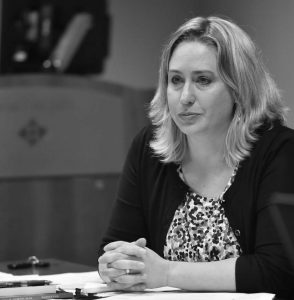
Guest – Professor Angela Walch teaches at St. Mary’s University School of Law. Her research focuses on money and the law, blockchain technologies, governance of emerging technologies and financial stability. She is a Research Fellow of the Centre for Blockchain Technologies of University College London. Walch was nominated for “Blockchain Person of the Year” for 2016 by Crypto Coins News for her work on the governance of blockchain technologies and her influential article in American Banker arguing that the coders and miners of public blockchains should be treated as fiduciaries.
——————

——————
CIA Sponsored Terror, Civil Liberties, Criminalizing Dissent, Gaza, Human Rights, Iran, Iraq War, Supreme Court, Truth to Power
Podcast: Play in new window | Download

Middle East Round Up: Brian Becker
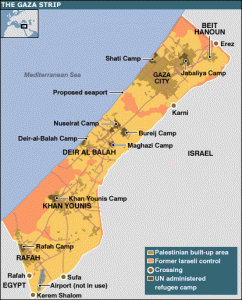
Iran and Gaza are at both at critical and potentially catastrophic junctures. Iran faces new challenges due to because of Donald Trump’s denunciation of the 2015 nuclear deal with Iran and the re-imposition of sweeping sanctions. As well, recent elections in Iraq pushed Iran’s allies in Iraq’s Shia militias–the Popular Mobilization Forces—into second place by nationalist Moqtada al-Sadr.
The element within the Republican Party with deep pockets is the Republican Jewish Committee. They support Netanyahu and his Likud party. The RJC supported both the blowing up of the Iran deal and the move of the Embassy to Jerusalem. Now they support Netanyahu’s crushing of the Palestinians in Gaza.
Iran also risks being diplomatically out-maneuvered. Israel Prime Minister Benjamin Netanyahu was in Moscow recently, aligning his interests in Syria with Vladimir Putin’s. In what is becoming routine coordination, Israel forewarned Russia of its attacks on Iran. Viewed from Tehran, Russia, Iran’s ostensible brother-in-arms in Syria, is more and more unreliable. Its Saudi foes are greatly encouraged by Trump’s offensive.
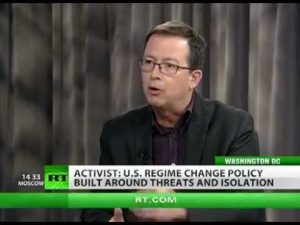
Guest – Brian Becker, the National Coordinator of the ANSWER Coalition and a leader of the Party for Socialism and Liberation. Brian has been a central organizer of the mass anti-war demonstrations that have taken place in Washington, D.C. in the past decade.
—-
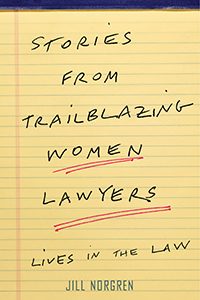
Stories From Trailblazing Women Lawyers
Before the Civil War there were six women lawyers in the entire United States of America. By 1890 there were about 200 and by 1900 about 1000. Women then could not even vote.
It was nearly impossible for a woman to get admitted to a law school or find a job when she graduated. Things did not qualitatively change until the late 1960s and 1970s.
By then, as a consequence of a number of factors including the great civil rights movement, the women’s movement, and the empty law school seats created by drafting men to serve in the Vietnam War, women were able to fight discrimination and win law school admission first by protesting in the streets and then through legislation, court decisions, and the actions of a few forward looking politicians.
Now half of the students in American law schools are women. They are professors in those very same places, indeed, the deans of the two most prestigious law schools in America, Harvard and Yale, are women. They are partners in law firms, hold important positions and governmental agencies, and are judges on the bench.
They have made a difference in the measure of social justice obtained by people in this country by advancing peoples’ and women’s rights in education, healthcare, employment, discrimination, family life, and violence against women.
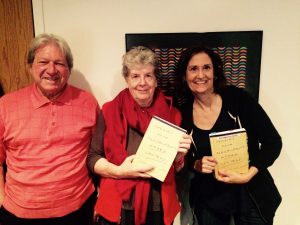
Guest –Jill Norgren, the author of the just published book Stories From Trailblazing Women Lawyers. Ms. Norgren is Professor Emerita of Political Science at John Jay College and the Graduate Center, the City University of New York. She is the author of several books including Rebels at the Bar.
————————
Civil Liberties, Criminalizing Dissent, Human Rights, Human Trafficking, Supreme Court, Torture, Truth to Power, War Resister
Podcast: Play in new window | Download
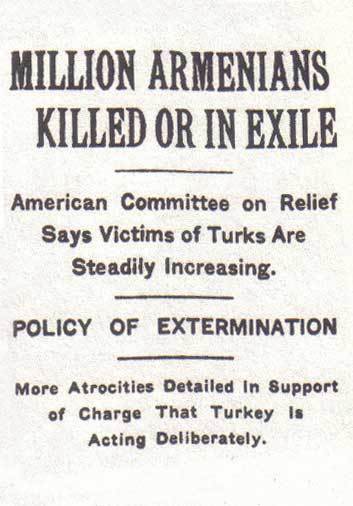
Speaking In Turkish: Denying the Armenian Genocide
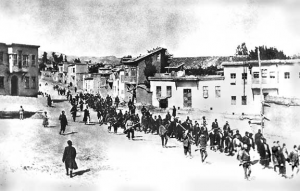
Around the world, April 24 marks the observance of the Armenian Genocide. On that day in 1915 the Interior Minister of the Ottoman Empire ordered the arrest and hangings of Armenian intellectuals and community leaders in Constantinople. It was the beginning of a systematic and well-documented plan to eliminate the Armenians, who were Christian, and who had been under Ottoman rule and treated as second class citizens since the 15th century.
The unspeakable and gruesome nature of the killings—beheadings of groups of babies, dismemberments, mass burnings, mass drownings, use of toxic gas, lethal injections of morphine or injections with the blood of typhoid fever patients—render oral histories particularly difficult for survivors of the victims.
Why did this happen? Despite being deemed inferior to Turkish Muslims, the Armenian community had attained a prestigious position in the Ottoman Empire and the central authorities there grew apprehensive of their power and longing for a homeland. The concerted plan of deportation and extermination was effected, in large part, because World War I demanded the involvement and concern of potential allied countries. As the writer Grigoris Balakian wrote, the war provided the Turkish government “their sole opportunity, one unprecedented” to exploit the chaos of war in order to carry out their extermination plan.
As Armenians escaped to several countries, including the United States, a number came to New Britain, Connecticut in 1892 to work in the factories of what was then known as the hardware capital of the world. By 1940 nearly 3,000 Armenians lived there in a tight-knit community.
Pope Frances calls it a duty not to forget “the senseless slaughter” of an estimated one and a half million Armenians by the Ottoman Turks from 1915 to 1923. “Concealing or denying evil is like allowing a wound to keep bleeding without bandaging it,” the Pope said just two weeks before the 100th anniversary of the systematic implementation of a plan to exterminate the Armenian race.
Special thanks to Jennie Garabedian, Arthur Sheverdian, Ruth Swisher, Harry Mazadoorian, and Roxie Maljanian. Produced and written by Heidi Boghosian and Geoff Brady.
———————————————
CIA Sponsored Terror, Civil Liberties, Criminalizing Dissent, Death Penalty, FBI Intrusion, Habeas Corpus, Human Rights, Political Prisoner, Prison Industry, Supreme Court, Surveillance, Torture, Truth to Power
Podcast: Play in new window | Download
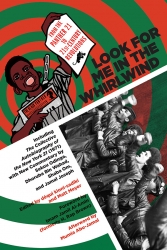
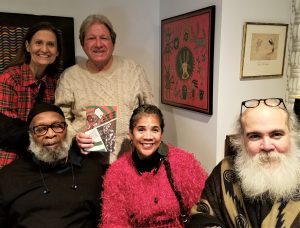
Look for Me in the Whirlwind: From the Panther 21 to 21st-Century Revolutions
The Black Panther Party was formed by community college students in Oakland California in 1966, the year after Malcolm X was murdered in New York City. It’s original name was the Black Panther Party For Self Defense.
The Black Panther Party set an example by its community programs and courage in declaring that it would defend itself against police brutality. The Black Panther Party spread westward from California to New York where chapters were organized in Brooklyn and Harlem, where Malcolm X was from. The Panthers frightened America’s elite. J Edgar Hoover and the FBI set out to destroy them and eventually succeeded. A great courtroom battle took place place in New York City shortly after the establishment of the chapters. Twenty one Black Panthers were framed up on baseless conspiracy charges.
They spent two years in prison including one year on trial. The jury was out for only one hour and acquitted them totally of all the baseless charges. The collective story of the New York City black panthers and their trial is told in the newly re-issued book Look For Me In The Whirlwind. The book is edited by Dequi Kioni-sadiki and Matt Meyer. It has a forward by Imam Jamil Al-Amin (formerly H. Rap Brown), the former head of the Student Nonviolent Coordinating Committee now in prison for life in Georgia and it contains an afterword by Mumia Abu-Jamal.
Guest – Matt Meyer is a New York City–based educator, organizer, and author who serves as War Resisters International Africa Support Network Coordinator, and who represents the International Peace Research Association at the United Nations Economic and Social Council. A former draft registration resister, Meyer’s extensive human rights work has included support for all political prisoners and prisoners of conscience, solidarity with Puerto Rico and the Black Liberation Movement, and board membership on the A.J. Muste Memorial Institute.
Guest – déqui kioni-sadiki is the chair of the Malcolm X Commemoration Committee and was a leader of the Sekou Odinga Defense Committee, which waged a successful campaign for the release of her husband. A tireless coalition-builder and organizer, déqui is a radio producer of the weekly show “Where We Live” on WBAI-Radio, Pacifica; an educator with the NYC Department of Education; and a member of the Jericho Movement to Free All Political Prisoners.
Guest – Sekou Odinga was a member of Malcolm X’s Organization of Afro-American Unity, a founding member of the New York chapter of the Black Panther Party as well as the Black Panther International Section, and was a member of the NY Panther 21. A citizen of the Republic of New Afrika and combatant of the Black Liberation Army, Sekou was captured in October 1981, mercilessly tortured, and spent the following thirty-three years behind bars—a prisoner of war and political prisoner of the U.S. empire. Since his release in November 2014, he has remained a stalwart fighter for justice and for the release of all political prisoners.
—-
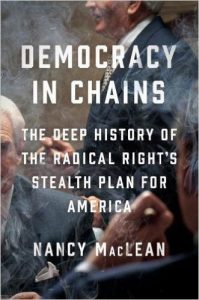
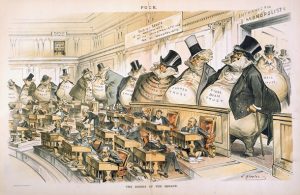
Democracy in Chains: The Deep History of the Radical Right’s Stealth Plan for America
The spectacle of President Donald Trump and the palace intrigue in the White House has served daily to distract people from the political strategy and accomplishments of the radical right, which is taking over the Republican Party.
Over time, the GOP has been transformed into operation conducting a concerted effort to curb democratic rule in favor of capitalist interests in every branch of government, whatever the consequences. It is marching ever closer to the ultimate goal of reshaping the Constitution to protect monied interests. This gradual take over of a major political party happened steadily, over several decades, and often in plain sight.
Duke University Professor Nancy MacLean exposes the architecture of this change and it’s ultimate aim. She has written that “both my research and my observations as a citizen lead me to believe American democracy is in peril”.
Guest – Professor Nancy MacLean, whose new book, Democracy in Chains: The Deep History of the Radical Right’s Stealth Plan for America, has been described by Publishers Weekly as “a thoroughly researched and gripping narrative… [and] a feat of American intellectual and political history.” Booklist called it “perhaps the best explanation to date of the roots of the political divide that threatens to irrevocably alter American government.” The author of four other books, including Freedom is Not Enough: The Opening of the American Workplace (2006) called by the Chicago Tribune “contemporary history at its best,” and Behind the Mask of Chivalry: The Making of the Second Ku Klux Klan,named a New York Times “noteworthy” book of 1994, MacLean is the William H. Chafe Professor of History and Public Policy.
CIA Sponsored Terror, Civil Liberties, Criminalizing Dissent, Habeas Corpus, Human Rights, Military Tribunal, NSA Spying, Political Prisoner, Prison Industry, Prosecution of the Bush Administration, Supreme Court, Surveillance, Targeting Muslims, Truth to Power, War Resister
Podcast: Play in new window | Download


Will the 911 Case Finally Go To Trial?
Sixteen years have passed since the 911 attacks. The truth of who was behind the attacks has come out in a class action lawsuit brought by more than 6500 victims and survivors. The lawsuit alleges that it was elements of the Saudi Arabian government that attacked us on 9/11. The Defendant in the lawsuit is Saudi Arabia.
The Saudi Arabian government hired 15 public relations firms to help them deny responsibility. They hired several Washington white shoe high powered connected law firms. They hid behind the law of sovereign immunity, which had to be overturned by an act of Congress in order for the lawsuit to proceed. They were helped by the US government in the cover-up by the Bush and Obama administrations. But after 16 years the case is now proceeding rapidly through the Federal courts and will either be settled or tried. The object of the lawsuit is to obtain money explained Sharon Pemboli, one of the plaintiffs and leaders of a group of women from New Jersey known as “the Jersey girls” who lobbied to win passage of the law which made the lawsuit possible. She believes that if the Saudi Arabian government is deprived of funds it will not be able to fund Al Qaeda and the extremist Wahhabi clergy responsible for supporting the terrorism of Al Qaeda.
The American public has been led to believe mistakenly that Saddam Hussein and Iraq were behind 911. The attack on Iraq was a war of aggression. At the end of World War II the United States set up the Nuremberg trials to try Nazi war criminals. They wanted to set forth principles that were not merely victor’s justice. At the Nuremberg trials the Germans were found guilty of starting a war of aggression, which was called the greatest of all crimes because it has contained within it all other crimes.
Guest – Andrew Cockburn, the Washington editor of Harper’s magazine. He has written an extremely important article in the October issue titled Crime and Punishment: Will the 9/11 Case Finally Go To Trial? about the class-action law suit brought by the victims of 9/11 against the government of Saudi Arabia.
—-


U.S. Magdalene Laundries and the Indiana Women’s Prison Researchers
From the 18th to early 20th centuries Catholic institutions known as the Magdalene Laundries in Ireland effectively enslaved unmarried mothers, where infants and mothers were subjected to brutal conditions and died in the hundreds. In 1993, a mass grave containing 155 corpses was uncovered in the convent grounds of one of the laundries. This led to media revelations about the operations of the secretive institutions Investigations into these homes have brought apologies and official compensation by the state of Ireland.
Few realize, however, that these homes also existed in the United States. Reports of the inhumane conditions in these homes has encouraged survivors of U.S. Magdalene Laundries to share their own their experiences. Surprisingly, few religious leaders, journalists and historians have yet to address and speak out about this chapter in our history.
That is, until scholars at the Indiana Women’s Prison began to research Magdalene Laundries, and their impact on girls and young women of all faiths across the United States for over 100 years. They believe that these homes were in effect the first prisons for women in the nation. And their work is being published and helping to spark a national discussion.
In a law review article that they published in the Journal of the Indiana Academy of the Social Sciences, the researchers note that their discovery of the laundries and their role in confining women is ‘stark evidence of historical amnesia.They say that the laundries played an important role in shaping attitudes toward female sexuality, identity, and societal reintegration.
Guest – Kelsey Kauffman, in 2012 she and two friends started a small college program at the Indiana Women’s Prison that has grown to 14 teachers and 80 students. She has worked as a prison officer and has taught in three prisons. Her research, which has taken her to more than 80 prisons on four continents, focuses primarily on the impact prison employment has on officers.
——————————————