Civil Liberties, Criminalizing Dissent, Cuba, Habeas Corpus, Human Rights, Political Prisoner, Prison Industry, Supreme Court, Surveillance, Targeting Muslims, Torture, Truth to Power, War Resister
Podcast: Play in new window | Download
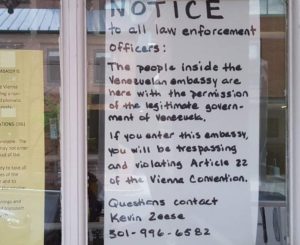
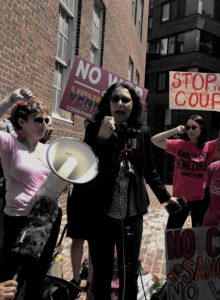
Venezuelan Embassy Protected Against Staged Attacks In DC
Democracy and the rule of law are being rapidly unraveled in our country by President Trump, his advisers, especially convicted war criminal Elliot Abrams, who was put in charge of policy in Venezuela, and John Bolton, who said that if the top 10 floors of United Nations building were lopped off it wouldn’t make any difference, and with the support of the rightist insurgent Republican Party.
The latest example is the American government’s failed attempt military coup in Venezuela and its support of the ongoing attack on the Venezuelan embassy here in Washington DC.
On April 30th, the United States tried and failed to overthrow the democratically elected Venezuelan president Nikolai Maduro. They fail to supplant him with Juan Guaidó, the self-proclaimed a president who’s only real power is outside of Venezuela and comes mostly from the Trump administration.
Back home in Washington DC right wing counterrevolutionaries in support of Juan Guaidó have so far failed in their attempt to take over the Venezuelan embassy. Under centuries of international law the embassy is considered the property of Venezuela itself.
Last week the Washington DC utility company, undoubtedly at the request of the US government, turned off the building’s water electricity supply. Washington DC police and the Secret Service are preventing people from bringing food and water into the embassy. A number of American citizens, acting in support of democracy in Venezuela, entered the building to protect it against an invasion by coup supporters. They are also demonstrating outside of the building. The embassy protectors are being represented by attorney Mara VerhaydenHilliard of the Washington DC Partnership For Civil Justice.
Popular Resistance, Answer Coalition, Code Pink
Guest – Attorney Mara Verheyden-Hilliard has in the past successfully sued both the Washington DC police department and the New York City Police Department for their abuse demonstrators. She is co-chair of the Guild’s National Mass Defense Committee. co-founder of the Partnership for Civil Justice Fund in Washington, DC, she secured $13.7 million for about 700 of the 2000 IMF/World Bank protesters in Becker, et al. v. District of Columbia, et al., while also winning pledges from the District to improve police training about First Amendment issues. She won $8.25 million for approximately 400 class members in Barham, et al. v. Ramsey, et al. (alleging false arrest at the 2002 IMF/World Bank protests). She served as lead counsel in Mills, et al v. District of Columbia (obtaining a ruling that D.C.’s seizure and interrogation police checkpoint program was unconstitutional); in Bolger, et al. v. District of Columbia.
—-
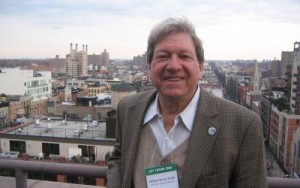
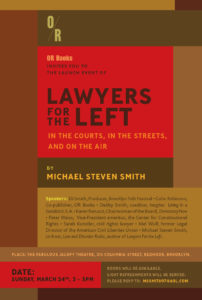
Lawyers For The Left: In The Courts, In the Streets And On The Air
Lawyers For The Left: In The Courts, In the Streets And On The Air is the title of the just published book by our own Michael Steven Smith. It profiles the some of the nation’s most effective agents of social change. Michael discusses how he came to write this book and previews several of the lawyers profiled therein.
As Chris Hedges quotes “The lawyers in this book valiantly fought the erosion of justice and assault on the court system.”
Portside Review by Bill Ayers:
Now open Michael Steven Smith’s smart and compelling Lawyers for the Left, and you’ll find yourself plunged into the contradictions and swirling through the vortex where that question—what is the law?—is on everyone’s mind all the time. It takes on a unique urgency and a fresh vitality as it’s debated case by case and issue by issue by these committed advocates battling against a system they see as deeply and unfairly stacked against their clients—Black freedom fighters, Puerto Rican independistas, Indigenous and immigrant rights activists, women warriors, anti-war militants, water defenders, dissidents and radicals. None of the lawyers you’ll meet here holds fast to the traditional view that the law is simply a civilized mechanism for resolving disputes in an intelligent and reasoned way. They agree, rather, that any honest analysis of the law begins elsewhere, noting that in all times and in all places, the law is constructed in the service of whatever social/economic system created it. In other words, the law is a mechanism of control that works to protect and perpetuate existing social relations.
——————-
——————-
Afghanistan War, CIA Sponsored Terror, Civil Liberties, Supreme Court, Truth to Power
Podcast: Play in new window | Download
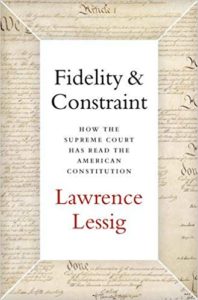
Fidelity and Constraint: How the Supreme Court Has Read the American Constitution
The U.S. Constitution is the oldest written constitution in the world. Interpreters of the Constitution are faced with the challenge of how, over time, to read a document that’s not only old but also inflexible.
In his new book Fidelity & Constraint, by Oxford University Press, Lawrence Lessig, one of the nation’s leading legal minds, explains that a fundamental approaches to interpreting the constitution is a process he calls translation. In fact, some of the most significant shifts in constitutional doctrine are products of the evolution of the translation process over time. In each new era, judges understand their translations as instances of “interpretive fidelity,” framed within each new temporal context.
Throughout American history, there has been a second fidelity in addition to interpretive fidelity: what Lessig calls “fidelity to role.”
In each of the cycles of translation the role of the judge — the ultimate translator – has also evolved. Old ways of interpreting the text now become illegitimate because they don’t match up with the judge’s perceived role.
When that conflict occurs, the practice of judges within our tradition has been to follow the guidance of a fidelity to role. Ultimately, Lessig not only shows us how important the concept of translation is to constitutional interpretation, but also exposes the institutional limits on this practice.
The first work of both constitutional and foundational theory by one of America’s leading legal minds, Fidelity & Constraint maps strategies that both help judges understand the fundamental conflict at the heart of interpretation whenever it arises and work around the limits it inevitably creates.
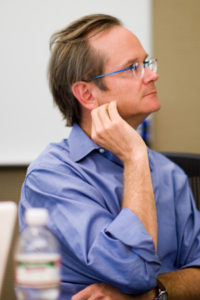
Guest – Lawrence Lessig is the Roy L. Furman Professor of Law and Leadership at Harvard Law School. Prior to rejoining the Harvard faculty, Lessig was a professor at Stanford Law School, where he founded the school’s Center for Internet and Society, and at the University of Chicago. He clerked for Judge Richard Posner on the 7th Circuit Court of Appeals and Justice Antonin Scalia on the United States Supreme Court. Lessig serves on the Board of the AXA Research Fund, and on the advisory boards of Creative Commons and the Sunlight Foundation.
—-

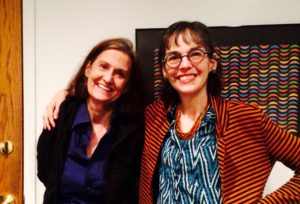
Free Range Kids
You may have heard about the shaming of parents who let their son or daughter walk to school by themselves, or ride public transportation alone. They’re often ridiculed on social media and cast as neglectful. But in some instances, the consequences have gone beyond public shaming.
In 2015 parents in Silver Spring, Maryland made national headlines they were investigated for child neglect for letting their children, ages 6 and 10, walk home from a park by themselves.
In another case Lenore Skenazy, a former New York Daily News columnist was called America’s worst mom after writing a column in 2008 about why she let her 9-year-old son ride the subway by himself.
Last year, Utah passed a law making it not a crime for parents to let their children play in a park without supervision or walk home alone from school. This is hopeful news for our guest Lenore Skenazy who has been advocating for so-called free range parenting laws for many years.
Under the law, neglect does not include allowing a child, whose basic needs are met and who is of sufficient age and maturity to avoid harm or unreasonable risk of harm, to engage in independent activities such as going to and from school by walking, running or bicycling, going to nearby stores or recreational facilities and playing outside.
A recent U.S. Census showed that 7 million of the nation’s 38 million children between the ages of 5 and 14 are left home alone on a regular basis, while the average time spent alone is six hours per week. Only a few states legislate an age under which kids may not be home alone.
Guest – Lenore Skenazy – New York City columnist-turned-reality TV show host got that title after letting her 9-year-old son take the subway, alone. In response to the enormous media blowback, she founded the book and blog, “Free-Range Kids,” which launched the anti-helicopter parenting movement. She has lectured internationally, including talks at Microsoft Headquarters and the Sydney Opera House, and has written for everyone from The Wall Street Journal to Mad Magazine. Yep. The Mad Magazine. And she’s a graduate of Yale.
———————
———————
CIA Sponsored Terror, Civil Liberties, Criminalizing Dissent, Guantanamo, Habeas Corpus, Human Rights, Iraq War, Political Prisoner, Supreme Court, Surveillance, Targeting Muslims, Torture, Truth to Power
Podcast: Play in new window | Download
Misuse of Grand Juries And The Prosecution Of Chelsea Manning
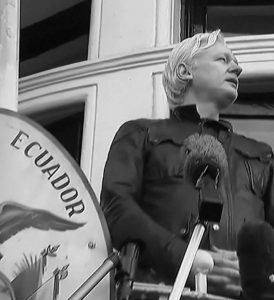
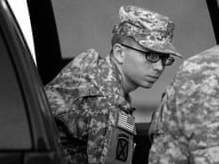
The Trump administration wants to prosecute the news organization Wikileaks and its founder Julian Assange. In order to do so they have recently jailed whistleblower Chelsea Manning, who has been in solitary confinement since March 8th, 2019 in hopes to squeeze her to get testimony that could be used against Assange. Prolonged solitary confinement is a form of torture.
Chelsea Manning has refused to answer questions of the Government Prosecutor in front of a grand jury. In 2010 Chelsea Manning, then in the Army, released documents to WikiLeaks known as the Iraq War Logs. One of them was a video showing a U.S. Apache attack helicopter killing 12 people, including two Reuters journalists, two children and a passerby who stopped his van to rescue the wounded. She maintains that there’s nothing new to be learned and that she’s already given full testimony.
Chelsea Manning was convicted and served 7 years of a 35 year sentence before her sentence was commuted by Barack Obama. The prosecution of WikiLeaks for accepting leaked secret documents is a threat to press freedom and would criminalize journalism. The government is trying to frame Assange charging him with actively colluding with Manning, not just being a passive recipient of the leak. Historically grand juries have been misused in order to suppress political dissent.
Write to Chelsea Manning in solitary confinement:
Chelsea Manning
Ao181426
William G. Truesdale Adult Detention Center
2001 Mill Rd.
Alexandria, VA 22314
Guest – Attorney Michael Deutsch, an expert on the misuse of grand juries. He is a partner in the Chicago law firm The People’s Law Office and a former director of litigation at the Center for Constitutional Rights. He has represented political activists and victims of government repression. Among his clients have been the Attica prisoners in the 1971 uprising, Puerto Rican independence fighters, members of the black liberation movement, grand jury resistors, and Palestinians falsely accused of terrorism.
—-
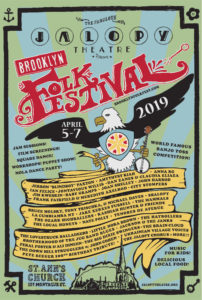
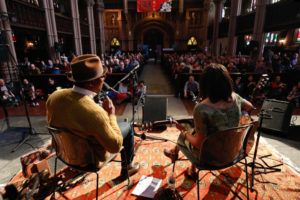
The Brooklyn Folk Festival April 2019
In the political radicalizations and social upheaval’s within the United States of America in the 30s and again in the 60s, we saw an increased interest in folk music. This phenomenon is repeating itself today. We speak today with Eli Smith, the producer of the Brooklyn Folk Festival. He is a banjo player, a folklorist, and a member of the string band The Downhill Strugglers. The Brooklyn Folk Festival is the largest of its type in the country and is now in its 11th year. It takes place in Brooklyn Heights at the historic Saint Ann’s Church this April.
Guest – Eli Smith, a musician, producer and activist from Brooklyn, who has helped organize the event. Eli Smith is also a folklorist and music producer who organizes the annual “Brooklyn Folk Festival.”
—-
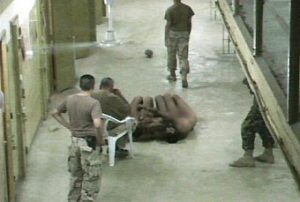
U.S. Appeals Court Opens Abu Ghraib Prison Abuse Case
In 2016, the United States appeals court re-instituted the Abu Ghraib prison abuse case against a private military contractor CACI. Since that time, the plaintiffs have had multiple victories.
The Center for Constitutional Rights is representing the abused prisoners. CCR‘s legal director Baher Azmy said “There is no question that torture is unlawful under domestic, military, and international law. The only issue in this case is whether CACI Will be held accountable – or treated with impunity – for its role in torture at Abu Ghraib. Now, the case is set for trial in Alexandria, Virginia on April 23.
Guest – Attorney Katherine Gallagher filed the case nearly 11 years ago and she is a Senior Staff Attorney at the Center for Constitutional Rights. Katherine works on universal jurisdiction and international criminal law cases involving U.S. and foreign officials and torture and other war crimes, and cases involving private military corporations and torture at Abu Ghraib. Her major cases include Al Shimari v. CACI, the international U.S. torture accountability cases, and Survivors Network of those Abused by Priests (SNAP) v. Vatican, seeking accountability for the crimes against humanity of sexual violence by clergy and cover-up.
———————
———————
CIA Sponsored Terror, Civil Liberties, Criminalizing Dissent, Human Rights, Political Prisoner, Prison Industry, Supreme Court, Surveillance, Targeting Muslims, Torture, Truth to Power, War Resister
Podcast: Play in new window | Download
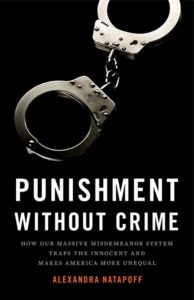
Punishment Without Crime: How Our Massive Misdemeanor System Traps the Innocent and Makes America More Unequal
In the overburdened U.S. criminal justice system, with its burgeoning prison population, we hear a lot about felony convictions. Felonies are crimes usually punishable by a term of more than one year, or the death penalty. What we don’t hear much about are misdemeanors, low level offenses punishable by fines or short terms of imprisonment in local jails.
With ten million petty cases filed annually, most U.S. convictions are misdemeanors. Unlike felonies, however, their processing is typically informal and deregulated. Much like fast-food justice, they have high-volume arrests, weak prosecutorial screening, an overtaxed defense bar, and high plea rates. There is often little meaningful scrutiny to see if convictions are supported by evidence. Innocent people who can’t afford bail often plead guilty just to get out of jail.
What the result of misdemeanor convictions? It’s pretty serious: stigma of a criminal record, misdemeanants are often heavily fined, incarcerated, and/or lose jobs, housing, and educational opportunities. Petty convictions are more frequent and burdensome even as we devote fewer institutional resources to ensuring their validity.
The misdemeanor phenomenon has profound systemic implications. It invites skepticism about whether thousands of individual misdemeanants are actually guilty. It reveals an important structural feature of the criminal system: that due process and rule-of-law wane at the bottom of the penal pyramid where offenses are pettiest and defendants are poorest. Misdemeanor processing is the way poor defendants of color are swept up into the criminal system with little or no regard for actual guilt.
In her new book, Punishment Without Crime: How Our Massive Misdemeanor System Traps the Innocent and Makes America More Unequal, Law Professor Alexandra Natapoff takes an in-depth look at the misdemeanor process is an institutional gateway that explains many of the criminal system’s dynamics and dysfunctions.
Guest – Alexandra Napatoff, University of California Irvine law professor and a member of the American Law Institute. She’s also a former federal public defender, a community organizer, and the recipient of an Open Society Institute Community Fellowship.
—-
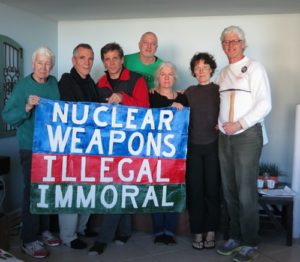
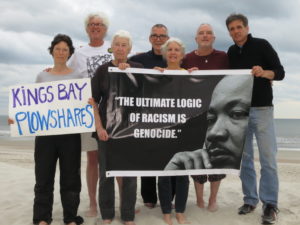
Kings Bay Plowshares 7
In our society nuclear weapons that can destroy all creation are taken as a normal, even an inevitable, part of life. In a dramatic action to break what they call “the crime of silence“ seven Catholic peace activists entered the Kings Bay trident submarine base in Georgia last April to perform an act of symbolic disarmament.
They used hammers to follow the prophecy of Isaiah “to beat swords into plowshares” and poured blood to make holy what was evil in a sacramental action.
Kings Bay is homeport to six ballistic missile trident submarines, each of which deploy 16 trident missile’s carrying four or more warheads of at least 100 kilotons. The Hiroshima bomb was 14 kilotons. Each submarine thus has the distructive power of at least 500 Hiroshima bombs.
The plowshares seven face up to 25 years in federal prison. Their trial is coming up in the next month. Theirs was the latest of 100 plowshares actions around the world since 1980.
Guest – Martha Hennessey, Kings Bay Plowshares 7 co-defendant, activist and volunteer with the New York Catholic Worker.
Guest – Carmen Trotta, Kings Bay Plowshares 7 co-defendant, activist and volunteer with the New York Catholic Worker.
——————
——————
CIA Sponsored Terror, Civil Liberties, Habeas Corpus, Human Rights, Supreme Court, Truth to Power
Podcast: Play in new window | Download
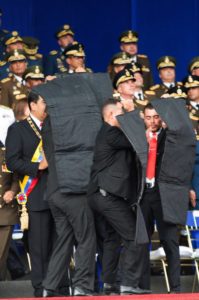
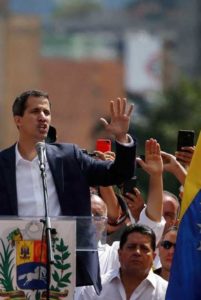
Venezuela Coup d’Etat
The last coup d’état the United States of America sponsored in 2009 in Latin America was under the Obama administration and supported by his Secretary of State Hillary Clinton when they overthrew a mildly social democratic president of Honduras. At that time the USA denied its role.
Today we are witnessing a quite open and blatant coup d’état in oil rich Venezuela against their recently and democratically elected socialist president Nicolas Maduro. The US boldly announced it no longer considered Maduro the legitimate president of his country.
In his stead the USA has recognized Jose Guida, an obscure legislator from the most right wing of the opposition parties after Vice President Mike Pence called him on the phone and gave him the blessings of United States government.
Venezuelan oil assets in the United States which amount to over $7 billion have been frozen. Likewise it’s $1 billion plus bank deposits in the United Kingdom have been seized. The United States has succeeded, in the infamous words of former Secretary of State Henry Kissinger, who engineered the coup against the elected Democratic Socialist President Salvador Allende in Chile on September 11 of 1973, “ to make their economy scream”.
The Venezuelan economy is now half its former size and hobbling along at a depression level. Food and medicine there is increasingly scarce. Tens of thousands of people have been forced to leave their country. Nevertheless, President Maduro has retained popular support including the support of the Venezuelan army.
Guest – Greg Grandin, a professor of history at New York University and a Nation editorial board member, is the author of a number of prize-winning books, including The Empire of Necessity, which won the Bancroft Prize; Fordlandia, which was a finalist for the Pulitzer Prize, the National Book Award, and the National Book Critics Circle Award; Empire’s Workshop; The Last Colonial Massacre; The Blood of Guatemala; and, most recently, Kissinger’s Shadow: The Long Reach of America’s Most Controversial Statesman. His new book, forthcoming this spring, is The End of the Myth: From the Frontier to the Border Wall in the Mind of America.
—-

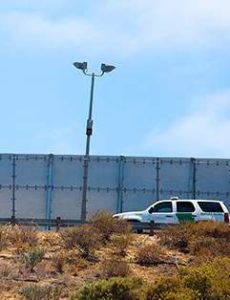
United States Executive Authority in Declaring Emergency Powers
U.S. presidents have the discretion to declare a “national emergency.” As soon as he does, he can sidestep many existing limits to presidential authority. In fact, 100 or more special provisions become available to him. Some provide reasonable responses to real emergencies, while others seem to bolster the power of a so-called unitary executive who wants to amassing or retain power. The president can activate laws allowing him to, for example, shut down many kinds of electronic communications inside the U.S. or to freeze Americans’ bank accounts. Other powers are available without a declaration of emergency, including laws that allow the president to deploy troops inside the country to subdue domestic unrest.
The rationale for having emergency powers is simple: The government’s ordinary powers may not be enough in times of crisis, and amending the laws to provide greater ones would take too long. Emergency powers are intended to give a temporary boost until the emergency passes or there is time to change the law through the regular legislative process. The problem comes when presidents don’t have the best interest of the country in mind.
Guest – Andrew Boyd, Counsel in the Brennan Center’s Liberty and National Security Program. Andrew spent 7 years prosecuting senior Khmer Rouge leaders on behalf of the UN for war crimes, crimes against humanity and genocide. He also worked on cases resulting from the 1994 Rwandan genocide at the International Criminal Tribunal for Rwanda.
———–
———–
CIA Sponsored Terror, Civil Liberties, Criminalizing Dissent, FBI Intrusion, Human Rights, Political Prisoner, Prison Industry, Supreme Court, Surveillance, Truth to Power, War Resister
Podcast: Play in new window | Download
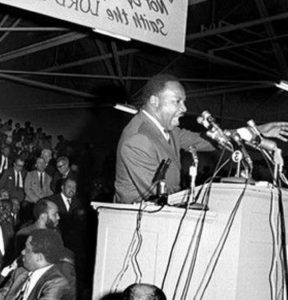
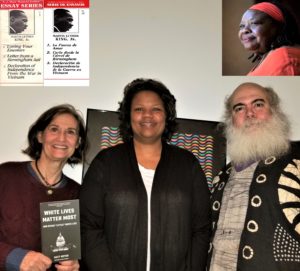
Honoring the Legacy Of Dr. Martin Luther King Jr.
Today on Law and Disorder we bring you a special hour-long program honoring the life and legacy of the Rev. Dr. Martin Luther King. Our listeners know all too well that the Nobel Peace Prize laureate was shot on April 4, 1968–51 years ago. Not so well known is the radical Dr. King, who said in the last months of his life that:
“Our only hope today lies in our ability to recapture the revolutionary spirit and go out into a sometimes hostile world, declaring eternal hostility to poverty, racism, and militarism. With this powerful commitment we shall boldly challenge the status quo.”
Joining us are special guests Ruby Sales, a colleague of Dr. King’s and co-founder of the Student Nonviolent Coordinating Committee; and Rev. Dr. Emma Jordan-Simpson, Executive Director of the Fellowship of Reconciliation (F.O.R.). We’re also joined by author and activist Matt Meyer, a board member of the AJMI.
Dr. King began close ties with A.J. Muste and with the F.O.R. during the Montgomery bus boycott, when FOR staff members Bayard Rustin and Glenn Smiley came to Alabama to support local efforts nonviolently challenging racial segregation. Dr. King developed a special relationship with former FOR chairman A.J. Muste, whose absolute pacifism King had, as a theological seminary student, questioned.
Before heading F.O.R., Muste was a prominent labor leader, helping to found the militant Congress of Industrial Organizations (CIO). And Dr. King, of course, was killed exactly one year after taking a staunch anti-Vietnam war position and in the midst of supporting a significant strike of sanitation workers, linking—as he had been—issues of race, class, and violence as King deepened his critique of the roots of oppressive U.S. society.
Guest – Ruby Sales is the founder and director of the “SpiritHouse Project”, a national organization that uses the arts, research, education, action and spirituality to bring diverse peoples together to work for racial, economic and social justice as well as for spiritual maturity. A life-long organizer, scholar and public theologian in the areas of civil, gender and other human rights, she was a member of the Student Non-violent Coordinating Committee and served as national convener of the Make Every Church A Peace Church movement.
Guest – Rev. Dr. Emma Jordan-Simpson is the Executive Pastor of The Concord Baptist Church of Christ, Brooklyn, NY. She has combined pastoral ministry with the social justice community. The former Executive Director of the Children’s Defense Fund she is now the Executive Director of the Fellowship of Reconciliation.
Guest – Matt Meyer is Secretary-General of the International Peace Research Association, Chair of the International Fellowship of Reconciliation’s Financial Advisory Committee, Africa Support Network Coordinator of the War Resisters International, and Senior Research Scholar at U-Mass Amherst. As current National co-chair of FOR and former Chair of the War Resisters League, he is second only to AJ Muste in holding the top post of those two historic US peace organizations. He is author of the recently published White Lives Matter Most And Other “Little” White Lies.
———-
———-